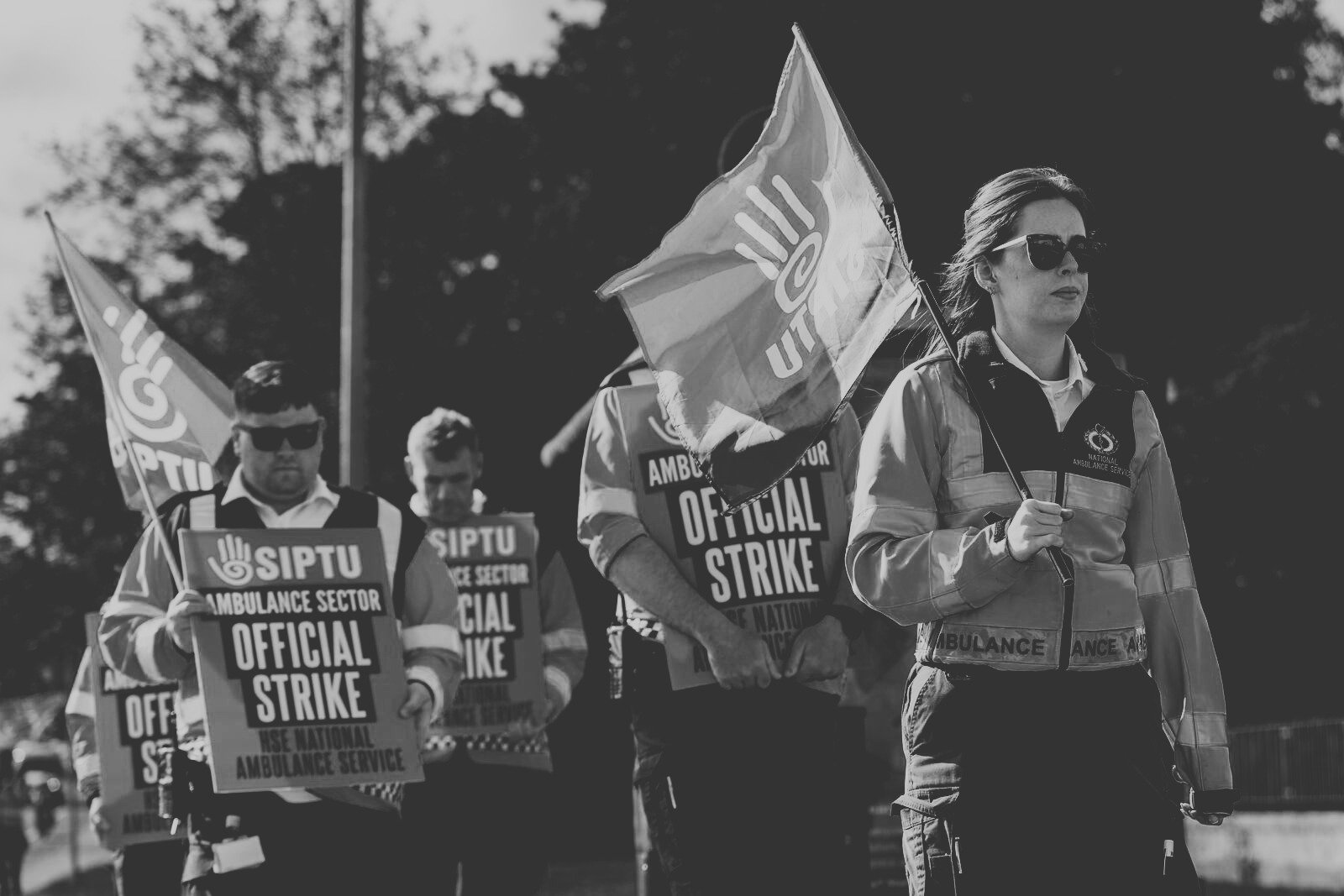
If trade unions are serious about changing the conditions workers live and work under, they cannot confine themselves to the workplace – they must organise, mobilise and fight on the political issues that shape workers’ lives.
As Rosa Luxemburg wrote, “There are not two different class struggles of the working class, an economic and a political one, but only one class struggle.”
At the heart of trade unionism is a simple idea: one worker has very little power, but workers acting together can have enormous power.
But there is a bigger question here. If workers have the power to collectively change the conditions under which they work, why should that collective power stop at the workplace door?
The problems facing working people do not begin and end with their employment.
A worker may have a decent workplace agreement but still be unable to afford a home. They may have a reasonable salary but spend a large proportion of it on rent. They may have secure employment but be waiting months for medical treatment.
These are not simply individual problems. They are social and economic problems. And this is where trade unionism can become something much bigger than a mechanism for resolving workplace disputes.
There are people who primarily live from the wealth they own, and there are people who primarily live from the work they do. That creates a fundamental common interest among working people.
Unions are key
This is one of the reasons unions are so important. They can help people recognise that many of the problems they experience individually are shared problems.
When millions of people experience the same problems, we should start realising that these problems are built into the way society is organised.
Capitalism likes to present social problems as individual problems. If you cannot afford a house, you are told to save more. If your wages are too low, you are told to improve your qualifications and on and on and on.
This is where the collective nature of trade unionism becomes important. Unions teach a very practical lesson: problems that cannot be solved by individuals can sometimes be solved collectively. People acting collectively can demand that society’s resources are organised differently.
The principle is the same: collective problems require collective power. Unions can be part of the fight for society.
In and beyond the workplace
For that reason, unions should not see their purpose as simply protecting their members inside their workplaces.
Of course, that work is essential. A union must defend workers against unfair treatment, fight for decent wages and protect conditions of employment. But if the union movement limits itself to those things, it risks fighting the symptoms while leaving the wider causes untouched.
Workers win a pay rise, but the increase is immediately swallowed up by rising rents. Healthcare workers can win better conditions, but the health service remains chronically underfunded.
These are not arguments for abandoning workplace trade unionism. They are arguments for recognising that workers’ lives extend beyond the workplace.
A union movement should therefore be involved in the wider struggles of society: housing, homelessness, anti-racism, for better public services, education, healthcare, the cost of living, inequality and the distribution of wealth. Not because unions should become political parties, but because working people cannot separate their working lives from the society in which they live.
They should have the opportunity to change the society itself.
Collective power
Unions are not simply service providers for their members. They are organisations through which working people can develop collective power. And collective power can change much more than a workplace.
A political General Strike is illegal under the Industrial Relations Act (1990) but a trade union should not regard existing laws and rules as beyond challenge simply because there are laws.
Where laws prevent workers from collectively acting on political issues that directly affect their lives and interests, workers can argue for democratic legitimacy in their collective capacity to challenge and change it.
A union’s fundamental responsibility is to organise workers collectively and to defend and advance their interests.
Where laws or institutional rules obstruct those interests, workers have the right to organise to change them – through campaigning, collective action, protest and civil disobedience. The existence of a law should not by itself determine what workers regard as just or unjust. But most of all, the workers’ greatest tool is the strike.
Contradiction
Thus, there is a contradiction at the heart of the modern trade union movement.
Unions were created because workers recognised that they could only protect themselves by organising collectively. The fundamental power of that organisation is the ability to withdraw labour. Yet, in Ireland, much of the union movement has increasingly become organised around not using that power.
The result is a strange situation where workers belong to organisations whose greatest strength is their collective ability to stop work, while those organisations can spend much of their time finding ways to resolve disputes without workers ever having to exercise that power.
So, are unions using the power that workers have given them? Are the unions truly representing their members in the fullest sense? Are they working to ensure that their members are fully protected from the harshness of a capitalist world?
The union exists to organise the collective power of those workers. That means the power to strike is not really the power of the union bureaucracy. It belongs to the members. The union is supposed to organise that power, protect it and, when necessary, use it.
Using their power
This creates a serious problem when the structures of industrial relations become more concerned with preventing industrial action than with building workers’ power.
If we believe that workers have collective power, then we must believe in using that power. Trade unions cannot be reduced to organisations that negotiate the terms of employment within the society as it exists. They should be organisations through which working people can organise, mobilise and fight to change the conditions of their lives and, ultimately, the society in which they live. The power of the union does not belong to its structures, its officials or its procedures.
It belongs to the workers who make up the union. The question, therefore, is not simply whether unions have power, but whether workers are being encouraged to recognise that power, to engage with it and to use it. And by workers we mean those who work by hand and brain, blue collar and white collar, everyone whose surplus labour is stolen by those who have capital.
If the problems facing working people are collective problems, then they require collective solutions. And if workers acting together have the power to change their workplaces, there is no reason why that collective power should stop at the workplace door.
