On the Friday of Marxism, before things had kicked off, I was moving boxes of t-shirts and posters on a trolley to where the event was being held. In the second lift I had to take, the trolley’s wheels got stuck in the door as I attempted to get out. I was trapped. It was at this point that I began to ask myself, “Is this advancing the cause of Marxism in Ireland today?” “In the context of a globe dominated by violence, imperialism, resurgent fascist ideas, and a whole host of deeper existential threats to humanity, what is the value of hosting an event like Marxism?” Within a minute, a comrade had helped drag the trolley out of the lift, and I was free again. Free to move boxes around the UCD Student Centre, and free to consider these questions more deeply.
Some of the first to arrive were comrades from the north, who had travelled down early to help with the more mundane end of organising, as well as to add to the politics of the weekend. Following them were the dozens of volunteers from across the island who had signed up to help chair meetings, guide attendees, give talks, and all the other business that makes Marxism possible.
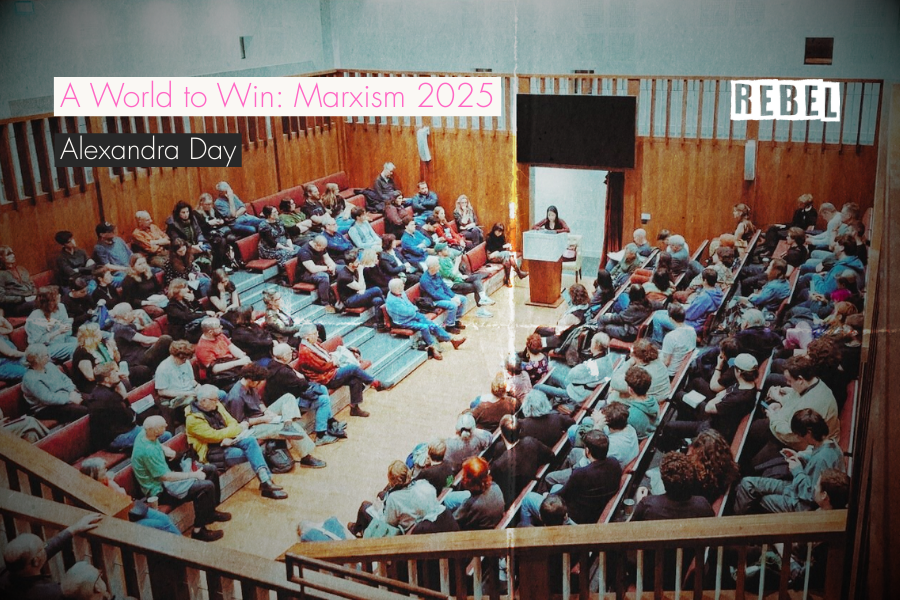
The diversity of age and experience struck me. Here we had teachers, students, retired people, carers, retail workers, bar workers, nurses – the whole range of professions – gathering from across the island (and the globe) for a weekend of explicitly Marxist discussion and debate. People I have known for many years, and people I was meeting for the first time. As more attendees filtered in, despite the rising pitch of Storm Claudia outside, this dynamic became all the more pronounced.
On the Saturday, I gave a talk on the role of women in the Russian revolution, and what their experiences teach us about political education and organising precarious workers. One of the key lessons I take from this topic is that we can only advance our understanding of the world, and consequently our ability to change it, when we take seriously the need of learning from one another. This was a phenomenon I observed in every meeting and film screening I attended throughout the weekend. Marxism this year was notable for the real space it offered everybody – from the most seasoned activists to those who had heard of the event the day before – to ask questions and to learn. People spoke from their own experiences and knowledge, resulting in a schedule of meetings that was much more than the sum of its parts.
This conversation did not come only in the form of the classic ‘speech-discussion-conclusion’ format. Some of the deepest and most considered conversations over the weekend occurred in the film screenings led by Rank’n’File Collective, Red Umbrella Éireann, and Bana Abu Zuluf, as well as the inimitable Ceachta Beaga Gaeilge IV zine workshop. These novel forms of political education facilitated great discussion of the ideas at the core of Marxism, and encouraged people to participate in every way they could. The themes of the rest of the meetings over the weekend, from the global to the local, spoke to the potential we have to change things when we come together. From revolutionary history to music to the struggle for trans liberation to the environmental cost of colonialism to the meaning of community, the breadth of discussion demonstrated the knowledge and experience we need to draw upon in our struggles.
The plenaries, which rounded off each evening, spoke to all the deeper challenges and opportunities preoccupying us all: the road ahead for a fighting movement of the left, the future of a movement dedicated to a fully liberated Palestine, and how we can overcome the poison of the far-right in our world today. With speakers from Palestine, Italy, Egypt, the United States, England, and across Ireland, these plenaries spoke to the necessity of joining the mass element of struggles across the globe with a class-based analysis.
Whether on the question of advancing the Palestine movement or how we can draw people away from the politics of despair, each plenary underscored the vitality of being organised both as workers and as socialists to answer these questions. Though in Ireland, and many other parts of the world, the trade union movement remains slow, bureaucratised and non-militant, the example of strike action taken by Italian dockworkers, as outlined by Lucia Pradella at Friday’s plenary, demonstrates how even a right-wing government can be compelled to do things it doesn’t want to do when masses of workers take action.
Moreover, how we translate this type of action into a direct confrontation with the rising racism in society was taken up by Eli Kane in his closing remarks of the weekend on behalf of United Against Racism. It is true that we must engage with the material struggles that so often bring workers into confrontation with the state in the most immediate sense, but within this activity we cannot shy away from the issues of racism, sexism, homophobia, and all other forms of bigotry. The plenaries across the weekend gave an insight into how we can go about bringing together these differing fights into a genuinely collective, transformative type of struggle. At the core of this was a call to get organised.
The thread that connected every meeting, every plenary, every chat over a pint, was the fundamental understanding that a better world is possible. With the scale of crises facing humanity, it can be easy to overlook this fact. As was so poignantly illustrated in the screening of ‘The Wanted 18’, hope and optimism are crucial tools for our movements. They aren’t ‘nice’ or ‘soft’ additions to the serious business of organising, but the foundation of any durable revolutionary strategy. We have the means at our disposal to make the world better, whatever the present tells us. That is, ourselves.
Ultimately, a Marxist understanding of the world is optimistic in that, though we have a clear picture of the massive battles ahead, it forces us to identify who the people are capable of changing things, and who are the people who make the world work. Crucially, that is the vast majority of people. Racialised people, women, queer people, migratory people, people who work in precarious fields or on the margins – these all make up the bulk of the working class today globally. This further shows how our struggles on the ‘social’ are fundamentally interlinked with the ‘economic’, and anyone who tries to divide those is mistaken.
As shown in the sheer variety of meetings over the weekend, a Marxist understanding of the world takes seriously every facet of our existence, rather than crudely itemising and ranking certain struggles over others. It is only by understanding this that we can face reality soberly, and simultaneously seek there the forces necessary for change.
I always feel a bit sad on the Sunday of Marxism when the ‘well I’d better hit the road so’ comments start to filter in. People begin to return home to their various corners of the island (and the globe), and it can be so easy to get lost in the essential yet challenging realities of day-to-day local organising, much less life. This speaks to the necessity of getting organised as Marxists on a national level.
However, by Sunday, I had the answers to the questions I had asked myself in the lift. Marxism 2025 reminded us all that, while the issues we all face are interlinked, so too is our ability to fight back. Marxism reminds us that, while we take seriously the issues that colour our reality, like housing maintenance or road conditions or playgrounds, we remain rooted in a bigger perspective. When we organise as Marxists, we can set our sights towards the necessary goal of changing the world.
That is a tall order, yet the world is already transforming whether we like it or not. We have a role to play in deciding what that transformation looks like. After the weekend, I feel confident that it can be for good, and for us all.
