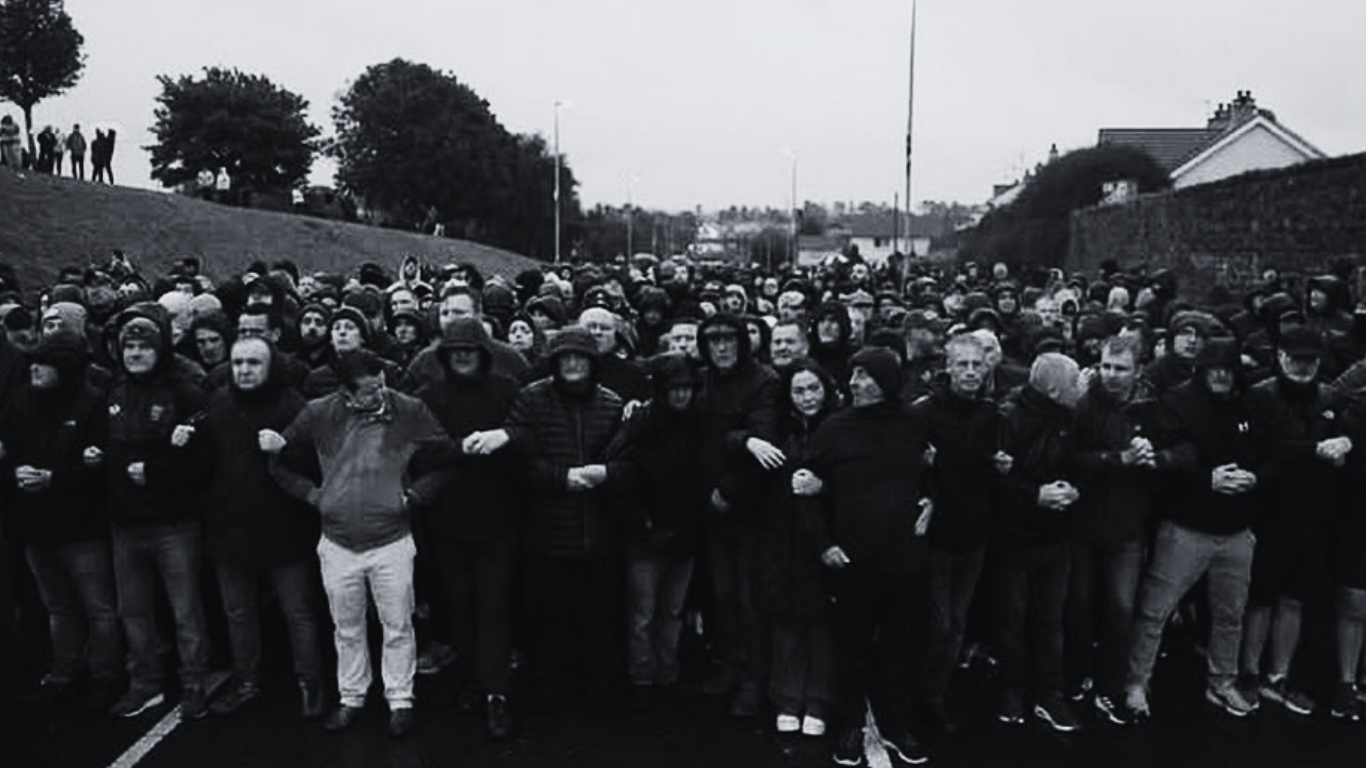
The clashes in Portadown between Orange marchers and nationalist residents have widely been reported as reflecting sharp and essentially irreconcilable differences between “the two communities”.
This is, at best, a distortion designed to accommodate the notion that Catholics and Protestants are gripped by 17th century ideas which pitch them against one another.
This is the approved analysis of Northern Ireland as two communities at loggerheads. They have to be persuaded by more enlightened folk to split their differences and try to live peacefully alongside one another. Both sides will have to make compromises.
But there are no two sides to this dispute – just as there were no two sides to the clashes between civil rights marchers half a century ago and loyalists wielding cudgels to drive them off the road. In this perspective, the Drumcree crisis is nothing but the same old story.
Working-class families have been listening to this sort of palaver since before our grannies were born.
Orange Order
To understand this complex situation is to keep in mind that the Orange Order is a thoroughly sectarian organisation for Protestant people only.
This is what the Order says about itself. No Catholics need apply, or Muslims or Jews or Holy Rollers.
This is not to say that all members of the Order are sectarian bigots. It is to say that as a semi-secret organisation open to adherents of one religion only, it harbours bigotry at its heart.
Why has the march from Drumcree Church along the Garvaghy Road been raised now, 28 years since the death of the three Quinn boys who died because of a sectarian attack on their home?
Their deaths had brought to 20 the number of people who had died because of the years of strife around Drumcree. The assassination of solicitor Rosemary Nelson the following year brought the total to 21.
The renewal of the demand to march through an area in which it’s not welcome and through which there is no reason for it to traverse, came on the back of a court case.
After the Parades Commission’s determination in relation to this year’s July march was published, a judicial review of the decision was lodged by the Orange Order. The Parades Commission determination was quashed because of ‘procedural errors’.
This judgement was greeted by DUP leader Gavin Robinson as a “totemic victory” and by DUP MP Carla Lockhart as “seismic”.
The judgement threw a lifeline to the DUP which has seen its support in the polls plummeting to 15 per cent following the conviction of its former leader, Jeffrey Donaldson for child sexual abuse.
After his conviction, a BBC Spotlight programme revealed the extent of hypocrisy at the highest levels of the DUP. Donaldson had described homosexuality as sinful in a 2006 Assembly debate.
But senior police officers had observed him entering a London sauna known as a meeting place for gay men.
It also emerged that a man who had presented himself in Northern Ireland as teetotal was frequently drunk in Westminster and, on one official visit to China, had been so drunk he vomited over the Mayor of Beijing.
Donaldson and the DUP
A new application was made to the Parades Commission for a parade down the Garvaghy Road on Sunday 27th Sept, the weekend after Donaldson was back in court for pre-sentence hearings.
The Commission’s determination stated that “The police made both written and oral submissions, indicating that they, at the time of making them, had no information indicating that the parade would result in disorder or violence.”
On this basis, it was given the go-ahead. Strict conditions were imposed: only 35 men could march, with no band and only one banner; the march would begin no later than 08.00 and would have to disperse from Portadown’s Carleton Street Orange Hall no later than 09:30.
The Drumcree crisis certainly meant that no one has been talking about Donaldson. It was inevitable that the North, the NI Executive and the Assembly would be thrown into crisis if the parade was given the go-ahead.
But the DUP gambled that whipping up sectarianism like it was 1999 would bring their voters back.
No one who was here during the 1990s could think that an Orange parade could walk peacefully down Garvaghy Road – unless it was, as the Garvaghy Residents’ Association had suggested in the 1990s, accompanied by local school children in their GAA jerseys.
The Orange Order wasn’t interested in a march that didn’t express their traditional domination of the area.
As this article is published, it looks unlikely that the Orange parade will go ahead – mainly because the residents of the Garvaghy Road have made it clear that they will, if necessary, block it.
As a result, the British Secretary of State may ban it or the courts might rule that the determination for a march on 27th is now expired and a new application will have to be made to the Parades Commission.
It is highly unlikely that the PSNI will use force to clear the road; the force is already highly unpopular in most nationalist areas and finds it almost impossible to recruit and maintain Catholics to the force.
Stormont may collapse if the march doesn’t go ahead; it will almost certainly collapse if force is used against the Garvaghy Road residents.
There is a positive side to all this. The BBC noted that young people from Protestant parts of Portadown had joined their counterparts from the Catholic parts on the Garvaghy Road.
People, especially younger people, from all kinds of Protestant backgrounds took to social media to tell the Orange Order and the DUP to “stop trying to drag us back”.
It might be that the DUP’s gamble will have lost it even more votes.
Eamonn McCann is a former MLA and a veteran civil rights activist.
