Is féidir an t-alt seo a léamh i nGaeilge anseo.
If a white man wants to lynch me, that’s his problem. If he’s got the power to lynch me, that’s my problem.
So the Black Power activist, Kwame Ture, is reported to have once said. There is a world of difference between the oppression visited upon people of colour in the United States and the situation facing Gaeilgeoirí in the North today. Yet in one sense Ture was addressing political problems that all marginalised groups run up against: what are we facing, and how do we respond?
From funding to signage, recent months have seen a renewed focus on the Irish language in the North, marked especially by an increase in Unionist attempts to curtail language rights. The following is a contribution to understanding this latest version of Unionist intransigence – and how our movement should push back.
Unionism in Crisis
In our post-Good Friday Agreement set-up, Unionism has a problem. Without the economic discrimination and necessary levels of patronage the Orange State once afforded, it struggles to secure the economic basis which in the past helped sustain the working class component of its base. As a result, Unionism must lean ever more heavily on beating the sectarian drum to try and keep this portion of its support sufficiently in-house. Yet it is precisely such divisiveness that has contributed to the contemporary demise of this once supreme political project.
Unionism has haemorrhaged some of its younger and more moderate support to Alliance. They need to keep the forces of loyalism on board – because that is key to re-election – but the method for doing so exacerbates the downward spiral, not only of the DUP but of unionism more generally. This is the strategic conundrum which has plagued the DUP in recent years; the organic crisis of Unionism.
Culture Wars
The DUP’s strategy for maintaining a shrinking base will be sectarianism, racism, sexism, transphobia, etc., all delivered via a ‘culture wars’ playbook. And for the Right, you win the culture wars by claiming you’re losing.
Around the world, the new Right are loud, unruly, dishonest, bigoted – and they’re on the attack. They prey on the increasing alienation and economic precarity facing ordinary people. They take justified anger at a deeply unequal system and purposefully misdirect it onto immigrants, non-whites and women, as well as the utterly tiny trans community.
The key weapon in their ideological arsenal? Painting themselves as victims. The Right tells a tale, a myth, that social groups who were once in the ascendancy (whites, men, straight people, etc.) are now being silenced[1]. In their argument, society is in such a state not as a result of capitalism, but because traditional gender, sexual and racial ‘norms’ have been displaced.
So corporations are criticised for ‘going woke’, rather than for paying poverty wages. The state is attacked for providing a modicum of hard-won representation to minority groups, rather than for viciously cutting services. The pandemic is pilloried as a ‘scamdemic’, rather than for the colossal and systemic failure to put the health needs of ordinary people ahead of the profits of big business.
The Right scapegoats minority communities because it insulates the economic system from any real criticism and it creates a sham fight with the more liberal wing of the establishment, allowing the new Right to pitch themselves as ‘outsiders’.
This ‘status-quo anti-capitalism’, to borrow from the Greek Marxist Nicos Poulantzas, is a potent approach precisely because it taps into the fact that large sections of the population are crushed by rotha móra an tsaoil under capitalism, that the liberal establishment is complicit in creating those miserable conditions, and crucially, that liberalism itself will provide no effective defence against a rising far right.
‘Price of a loaf’
It isn’t difficult to see how these ‘culture war’ tactics would appeal to hardline unionism. The days of blatant dominance are over and as Bernadette McAliskey explained in 2016:
Of course, this feeling didn’t fall from the sky. It has been actively stoked by unionist politicians and loyalist mouthpieces: the nationalist ‘plot’ turning the North into a “cold house” for unionists; the erosion of ‘British’ identity and “our culture” etc.
In fact, as Seán Mitchell has detailed, it was part of a deliberate strategy of David Trimble and other Unionists around the time of the Good Friday Agreement to “recast Orangeism in terms of ‘identity’ and ‘culture’.” This was persuasive because “After all, sectarian triumphalism was one thing, but who could deny the right of someone to celebrate something as benign as their culture and identity?”
Sectarian Molotovs
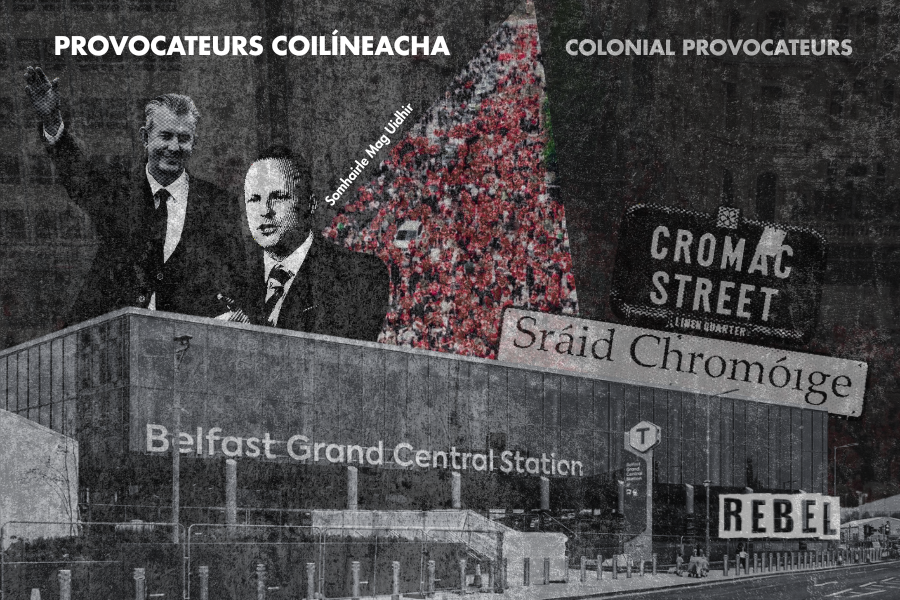
In the short-term, a loyalist agitator calling for a block on bilingual signs at Grand Central Station is a win-win. If they succeed, they have proven themselves an effective operator, a capable slayer of the Irish language crocodile. If they lose, it provides further fodder for the siege mentality upon which right-wing propaganda feeds.[2]
Gaeilgeoirí face a serious challenge when the DUP chuck these sectarian molotovs into our public discourse, therefore. We can’t opt out of confrontation because organised loyalism’s strategy of opposition to the Irish language won’t simply disappear.
But we should be aware that said strategy comes from a place of weakness. It is an expression of political unionism’s permanent crisis, a conscious attempt to shore up and radicalise a slowly dwindling loyalist base, rather than to expand and reclaim political hegemony. A wounded animal can still bite, of course – but whatever hurdles this ‘culture war’ throws up, they aren’t insurmountable.
Colonial Provocateurs
Ultimately, what these right-wing purveyors of hate live off is oxygen. Stopping a specific project or piece of legislation isn’t always the be-all-and-end-all, since failing to do so can then be spun into further proof of victimhood. And here we run up against the perennial ‘culture war’ conundrum – how do we respond without fuelling their fire?
In the case of Jamie Bryson, for example, his reach means it’s difficult to allow his ramblings to go unchallenged and to grow in confidence. Our objective is therefore a double one: we have to ruthlessly decimate sentiments that are rooted in a bad-faith anti-Irish sectarianism[3] and to simultaneously strive to do so in a way that denies giving these colonial provocateurs the attention on which they feed.
We need to undermine, refute, and provide alternatives to right-wing anti-Irish language ideas while, as far as practically possible, refusing the bigots their desired ‘culture war’. This won’t always be easy. It isn’t by accident that these charlatans have turned to offence-as-politics: it works, by evoking understandable anger in their chosen antagonist.
However, one method for pushing back on our terms, is to seek to speak past them, to argue not with Bryson or the DUP councillor or whoever directly, but to try and reach ears beyond theirs. This approach relies on the controversial assumption that ideas can change, that sectarian attitudes don’t have to be permanent. It is based on class politics.
An Áit is Tréine an Dúshlán
Whether it conjures them itself, or inherits them from the past, capitalism has proven itself adept at using the divisions between people to keep its costs low and its profits high. A system whereby people are forced to compete for jobs, houses and the means to a decent life – such a system is fertile ground for an ideology which seeks to blame ‘the other’. They might be motivated by wanting to keep capital happy, or by recognising that they can make gains via an us-versus-them style of politics, but in either case political establishments also reinforce the divisions within society. Sectarianism is one such divisionary tool.
The Kwame Ture quote above continues further:
Sectarianism, much like racism, sexism or transphobia, can’t be reduced to simply being a product of capitalism. But what Kwame Ture’s insight calls on us to do is that for whatever form our challenge to these injustices may take, opposition to capitalism must course through its veins.
Máirtín Ó Cadhain came to similar conclusions in different circumstances: “Sé dualgas lucht na Gaeilge a bheith ina sóisialaigh” (it is the duty of the Irish language community to be socialists), he said in his seminal speech in the late 60s, Gluaiseacht na Gaeilge, Gluaiseacht ar Strae. He continued with a call for Irish language activists to embed themselves in movements against capitalism, in defence of the oppressed, wherever such campaigns reared their heads:
How does this apply to the Irish language movement today? Infusing our Irish language activism with socialism is key to three related tasks before us: securing the resources necessary to sustain the language revival; depriving loyalist culture warriors of the ability to pit language rights against other, very real issues in our society; and breaking down the sectarian ideas that people might hold about the language.
Language Revivals and Class Politics
Mainstream unionism has been very effective in keeping its base on board by asserting that the inequality and crises in our public services are down to unionists ‘losing out’ in the GFA set-up.
This argument has been deployed countless times to push against Irish language measures (“We shouldn’t be spending money on Irish signs while our NHS is in crisis” etc.) These are culture war talking points, but they have surface credibility precisely because public services in general are in dire straits. However, despite this challenging backdrop, the way to undercut these bad-faith sectarians is certainly not to make our demands appear more moderate in the hope of appeasing those who aren’t interested in rational debate.
Furthermore, language revivals require human labour: teachers, support staff, community workers, translators, language planners, youth workers and more. And that’s just the language-specific workers. Ultimately we need the wider services that exist in society provided through the minoritised language. All of this costs money. Of course, the amount spent on Irish, especially Irish signage, is a drop in the ocean compared to that budgeted for the NHS every year. But the real resources necessary to do justice to the scale of the growth of pobal na Gaeilge in the North are great, and we should never baulk at saying so.
Rather than downplaying our demands, we need to combine arguments in favour of language rights with a vociferous defence of those same services and resources we want provided in Irish. Gaeilgeoirí should be unequivocally associated with protecting public services, involved in campaigns demanding healthcare and housing and all the other provisions to which working class people are entitled. We shouldn’t confine ourselves to demanding bilingualism in stretched hospitals, marketised universities, or increasingly expensive transport services. Instead, we have to recognise that years of austerity and insufficient financing not only decimates services but hurts the language too.
This is what class politics are about: actively melding together economic demands with social ones like language rights or anti-racism or a defence of the trans community. And it is class politics such as this which has the unique capacity to speak past the culture wars, without sacrificing an inch on our language demands. This latter point is critical. As Barney Doherty has argued recently in his excellent piece on anti-racism in Ireland, there’s no room for “flinching” before the far right: the left must hold the line on immigration, trans rights, and indeed, the Irish language.
And while this article has been Northern-focused – as it has been about responding to Unionism – in the age of receding Gaeltachtaí and housing crises south of the border, the question of providing the funds and services necessary to protect and grow the language is front and centre there too. Capitalism, with its insatiable thirst for profit over all else, represents an existential threat to minority languages the world over, whether a political class is Unionist or not[5]. In the case of the Irish language, it’s an all-Ireland problem, ultimately requiring all-Ireland socialism.
Winning Majorities
The strategic orientation outlined above is crucial to sustaining support for the language revival too. When it comes to any movement, it is possible to separate the wider population into three groups. There are those who are resolutely with you, there are those who are adamantly against you, and there are those who fall into a third camp: usually a majority of people somewhere in between, with a range of different ideas and contradictory thoughts.
In the North, the Irish language movement in 2017 managed to invigorate and grow those who were with us, dampen the spirits of the sectarian anti-Irish brigade, and make crucial inroads into that third grouping.
This latter portion included parts of the growing section of the Northern population which wouldn’t identify as either ‘green’ or ‘orange’, often crudely thought of as voting Alliance. And it had within it people who once maybe held vaguely ignorant or discriminatory ideas about the language.
It also contained large swathes of the nationalist community who may have previously held no ill-will towards the language, but neither would they have been motivated nor had the understanding to defend language rights. Making real advances into these different sections of the majority that stood somewhere between out-and-out support and objection proved absolutely critical to the gains made in recent years and the improved standing the language enjoys in Northern civil society today.
Majorities aren’t fixed, however. They must be constantly fought for and renewed. The importance of a socialist approach to the language also relates to winning this politically diverse, uncommitted majority to our side again and again.
And we shouldn’t be so complacent to think that this perspective has only to do with people who originate from communities other than the nationalist one. Things are bad out there; racism is on the rise, and not only in loyalist areas which has often been the charge. The economic situation is much worse than even what it was in 2017. It will not do pobal na Gaeilge well, in the long if not the short, if alongside increased investment in this or that Irish language measure the services and social safety nets people rely on continue to evaporate. So too, some nationalist politicians should be wary that those in nationalist communities who might be convinced to support the Irish language more vociferously can also be put off by a growing cynicism at smiley-faced selfies beside Irish street signs as the state of those streets and communities deteriorates.
To be clear, the demand for Irish language rights, from signs to full on bilingual services, is totally justified on its own terms; linguistically, politically, morally. But this doesn’t negate the fact that pobal na Gaeilge faces a decision. Do we fight for Irish language rights in a linguistic silo, divorced from the wider society in which working class people live, Gaeilgeoir and non-Gaeilgeoir alike? Or do we strive to connect the campaign for Irish in our services with the quality of those same services, to connect the vision of a saol trí Ghaeilge with a vision for that saol in which working class people can live with real dignity, free from capitalism’s vice grip?
Shoots of Change
There is a dominant narrative championed by the establishment in London, Dublin and Belfast. It claims that sectarianism is ingrained, a mollusc latched onto the rocks of people’s brains, so heavy that not even Fionn MacCumhaill could dislodge it.
Once sectarianism, or any other reactionary view like racism or sexism, is held to be fixed, you remove any need to interrogate its social, political and economic roots. Deprivation and alienation are made irrelevant to the story. What matters for people in loyalist communities, in this reading, is only one half of McAliskey’s point above: that the shinners are “up running the country” and not that people “still don’t have the price of a loaf”.
Widespread in his day, Marx spent a great deal of time and effort arguing against this conservative ideology that said reactionary sentiments were immovable. It is conservative because it gets the ruling elites off the hook for their fundamental responsibility for propagating such reactionary ideas, and it embeds the very divisions we’re seeking to overcome.
Marx wrote at length to show that ideas are highly malleable and fluid, because they’re eminently responsive to the conditions of people’s day-to-day lives, and how we act to change them. ‘It is not the consciousness of humans which determines what they do, but what they do which determines their consciousness.’
In 2019 Harland and Wolff workers went on strike to save jobs. They organised a protest at Stormont which coincided with one organised by An Dream Dearg. Gaeilgeoirí expressed support for the striking workers. Out of this, some of the workers requested a translation of one of their slogans into Irish, before proceeding to chant it through their megaphone.
In May 2023, youth services across the North were facing the brunt of civil servants implementing vicious Tory cuts. Irish language activists played an important role in the fight back, and when at a Belfast city centre rally anti-cuts chants in Irish were delivered from the stage, youth workers from a strongly loyalist area joined in i nGaeilge.
None of this is to say that in those fleeting instances sectarianism was overcome. No doubt, people who say one thing one day can say the opposite the next. But they remain significant examples of class solidarity momentarily opening the door to support for the language from people who, given our historical context, would be expected to feel anything but.
Our job is to nurture these shoots of solidarity, which are often more plentiful than we are led to believe. However, establishment perspectives would have us write the possibility off before we even began, lest we discover a dangerous truth: that united struggle from below holds the keys to washing away the muck of ages on the road to our collective emancipation.
You can read this article in Irish here.
[1] Things are certainly different for oppressed groups compared to the situation a few decades ago, but the idea that women, people of colour, the LGBTQ+ community have anything close to real equality is farcical.
[2] Of course, as noted above, this strategy of ultra-unionism is short-term because it further exacerbates the permanent crisis of unionism
[3] Sectarianism about the Irish language isn’t always consciously in bad faith. It can be borne of ignorance and other factors. We should make every effort to distinguish between the reasons for anti-Irish language words and deeds, and design our responses accordingly.
[4] The fáinne is a small circular pin worn by some Irish speakers to denote levels of fluency and goodwill towards the language.
[5] The makeup of the political class – whether it is dominated by Unionists as it was in the Orange State, by the representatives of Irish capitalism as it is in the Southern state, or dominated by some mix of the two as in the Northern state today – informs the particular strategies and tactics of our language struggles. But the fact of living in a capitalist system of any sort will mean that language struggle will always be necessary.
